OFFERED IN BROOKLYN AND STATEN ISLAND. APPLY TODAY!
Radiography
Master the Science of Medical Imaging.
Program Overview
Learn about what this program offers and what you'll achieve.
What is Radiography?
From emergency rooms to specialized clinics, Radiologic Technologists are the backbone of modern diagnostics. Our Radiography program prepares you to operate sophisticated radiation equipment to produce the high-quality images doctors rely on. We emphasize the "Patient-First" approach. You won't just learn the physics of X-rays; you’ll learn how to provide compassionate care while navigating the fast-paced environment of a major hospital system.
What does a professional do?
Careers in radiography have become more and more diverse as the field of radiology has evolved from the discovery of the x-ray to complex and sophisticated scanning methods like magnetic resonance imaging (MRI), computed tomography (CT), Mammography (M), Bone Densitometry (BD), Interventional Radiology (IR), and PACS Administration. As the technology has expanded, there has been an increasing need for highly trained professionals to fill the varied positions available to radiologic technologists.
Precision of Positioning: Success in Radiography requires a blend of technical accuracy and patient empathy. Our program emphasizes intensive hands-on lab training and clinical rotations, helping you master the precise positioning and equipment manipulation needed to capture high-quality diagnostic images while ensuring patient safety and comfort. Multi-Modality Foundation: We prepare you for success in the foundational pillars of diagnostic imaging. By mastering skeletal, chest, and trauma radiography, you build the essential expertise required to transition into advanced modalities like CT, MRI, or Mammography. This versatile training makes you an adaptable and highly valued professional in any hospital or imaging center. Board-Certified Excellence: We align our curriculum with the high standards of the American Registry for Radiologic Technologists (ARRT). When you graduate, you aren't just a student—you are a professional prepared to meet national benchmarks for excellence.
Professional Characteristics
- Deliver care with empathy, respect, and genuine concern for each patient’s well‑being.
- Apply analytical reasoning and sound judgment to make informed decisions in fast‑paced clinical environments.
- Maintain accuracy and precision in all tasks to ensure high‑quality outcomes and patient safety.
- Convey information clearly and professionally with patients, families, and healthcare team members.
- Work seamlessly with colleagues and interdisciplinary teams to provide the best possible patient care.
Program Highlights
- CAHE's curriculum is reverse-engineered from national board standards to ensure you don't just pass—you excel. CAHE's registry preparatory course and credentialing exam pass rates are the bridge between being a student and becoming a registered professional in a competitive market.
- Graduate with clinical maturity. By rotating through major hospital systems and leading imaging centers you move beyond the classroom to master high-pressure patient care. You won't just learn the theory; you will build the "muscle memory" required to be a clinician from your first day on the job.
- Receive expert mentorship. Our instructors are active clinicians in their fields who teach you the nuances of the "hidden curriculum"—the soft skills, technical shortcuts, and patient-interaction techniques that separate a new graduate from a seasoned employee.
- CAHE's program is designed for efficiency and intensity, allowing you to enter a high-demand field in less than two years. We value your time by focusing only on the skills that lead directly to employment and patient outcomes.
- Students deserve a path to a new career that respects your current commitments. CAHE offers Daytime and Evening/Sunday schedules so you can maintain your personal and financial stability while you work toward your professional transformation
Earn an Associate's Degree While You Train
Applicants who enter the program without a degree must enroll at CAHE's affiliated college to earn an associate degree while also earning a certificate from Center for Allied Health Education. Radiography program students who enter the program having previously achieved an associate degree or higher from a regionally accredited institution will earn a Certificate of Completion from Center for Allied Health Education's Radiography Program.
Program Structure
Format: Blended/Hybrid
Clinical rotations: Begin in the Third Term (840 clinical hours)
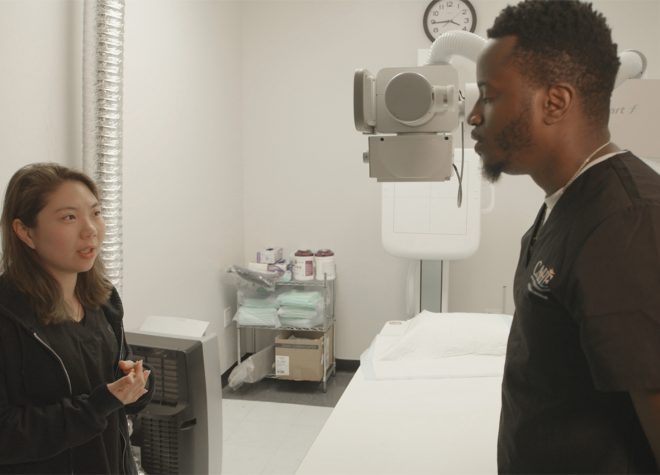
CAHE's program is designed for efficiency and intensity, allowing you to enter a high-demand field in less than two years. We value your time by focusing only on the skills that lead directly to employment and patient outcomes. Gain hands-on experience in CAHE's laboratory facility as well as clinical experience in medical facilities, ensuring you are day-one ready for your first job.
Program Pathways
Pathway A – Certificate of Completion
Duration: 22 Months
Pathway A is for students who enter CAHE with a degree from a recognized institution. Students in this pathway complete the required CAHE program coursework and, upon successful completion, receive a Certificate of Completion from CAHE.
Pathway B – Associate of Science Degree (Affiliated College Pathway)
Duration: 22 Months
Pathway B is for students who do not enter CAHE with a degree from a recognized institution. Students in this pathway are required to dually enroll at St. Francis College, CAHE’s affiliated college, and complete additional general education coursework. This dual enrollment allows students to earn an Associate of Science degree from St. Francis College prior to graduation, alongside completion of their CAHE program requirements.
Graduation Requirements
✓ Meet all academic requirements.
✓ Meet all clinical requirements and attain all required competencies.
✓ Successfully complete Career Development Workshop series.
✓ Meet all financial obligations.
✓ Complete an exit interview.
✓ Return their CAHE swipe card, Clinical Affiliate ID card, etc.
✓ Periodically review their radiation monitoring reports.
✓ Return their radiation dosimeter and badge holder.
GPA Requirement: C average (GPA of 2.0)
Completion Window: Students who have not fulfilled their graduation requirements have 20 weeks from their originally scheduled graduation date to complete all missing requirements.
Certification & Licensure
Professional credentials and licensing requirements.
Certification Exam
ARRT (American Registry of Radiologic Technologists)
Licensure Required
A temporary permit to practice radiologic technology (pending an examination) is issued at the time of graduation. Graduates should take the licensing examination as soon as possible after graduating, since the temporary permit expires after 180 days.
Click here for licensure requirements for all other states ↗Micro-Credentials
Upon successful completion of the program, graduates will also receive:
Basic Life Support (CPR), Blood Borne Pathogens (Infection Control), HIPAA
Mission & Goals
What we aim to achieve and how we measure success.
Mission Statement
The Radiography Program has made a firm commitment to the education of students in the field of Radiography. Our mission is the training of Radiographers who are skilled individuals, qualified by technical education, to provide services using various imaging modalities.
Goals
Objectives
Program Objectives
Upon graduation, students will receive a certificate of completion and are prepared to meet the requirements to sit for the written examination of the American Registry of Radiologic Technologists (ARRT) and to function as entry level Radiologic Technologists. Specifically, the program's objectives are to have our graduates perform effectively by: • Applying knowledge of radiation protection for patients, self, and others • Applying knowledge of anatomy, positioning and radiographic technique to accurately demonstrate anatomical structures on a radiograph • Determining exposure factors to achieve optimum radiographic technique with a minimum of radiation exposure to patients • Examining radiographs for the purpose of evaluating technique, positioning and other pertinent technical qualities • Exercising discretion and judgment in the performance of medical imaging procedures • Providing patient care essential to radiographic procedures • Recognizing emergency patient conditions and initiating life-saving treatment within their scope of practice
Student Learning Outcomes
• Students will apply positioning skills • Students will demonstrate appropriate use of equipment • Students will practice radiation protection • Students will employ proper techniques • Students will use effective oral communication skills with healthcare professionals and patients • Students will demonstrate effective presentation skills and written communication skills • Students will adjust all necessary elements to perform non-routine exams • Students will appropriately evaluate images • Students will demonstrate professional behavior • Students will understand ethical decision making • Students will understand the importance of obtaining membership in professional organizations and obtaining certifications for advanced modalities • Students will complete the program • Students will pass the ARRT National Certification on the first attempt • Graduates will be satisfied with their education and training • Graduates will be gainfully employed within 6 months • Employers will be satisfied with graduates' training
Credentialing Examination and Licensure
Center for Allied Health Education's Radiography Program graduates are qualified to sit for the American Registry of Radiologic Technologists National Certification Exam and New York State Department of Health licensure. The course of instruction follows the latest Standards for an Accredited Education Program in Radiologic Sciences as published by the Joint Review Committee on Education in Radiologic Technology (JRCERT).
Course Schedule
Class and clinical scheduling information.
Daytime Schedule: On-campus classes may be scheduled Sunday through Friday between the hours of 9:00 a.m. and 5:00 p.m. and are subject to change. Some classes are held in a hybrid/online format and up to 5 days a week. Clinical rotation schedules are generally Monday through Friday between 9:00 a.m. and 5:00 p.m. and are subject to change based on shift availability. Make-up sessions/activities may be conducted on Sundays. Evening Schedule: On-campus classes may be scheduled Monday through Thursday between the hours of 4:00 p.m. and 9:30 p.m., or 9 a.m. to 5 p.m. on Sundays and are subject to change. Some classes are held in a hybrid/online format. Clinical rotations for the evening cohort will be scheduled in the evening time, on Sundays, or during the daytime hours. Clinical rotations are subject to clinical shift availability. The schedule is subject to change and does vary each term. Students will be provided with their schedules for the following term 30 days prior to the start of the term.
Location
BROOKLYN: Center for Allied Health Education, 1401 Kings Highway, Brooklyn, NY 11229 STATEN ISLAND: Center for Allied Health Education, 1441 South Avenue, Suite 609, Staten Island, NY 10314
Upcoming Cohorts
RTR 27-02 – DAYTIME
Brooklyn, Staten IslandStarts: February 15, 2027
Ends: December 2028
Schedule: Day
Orientation will be held approximately one week prior to the start of the program.
RTR – 27-02 – EVENING
Brooklyn, Staten IslandStarts: February 15, 2027
Ends: December 2028
Schedule: Evening
Orientation will be held approximately one week prior to the start of the program.
Program Curriculum
Courses, hours, and what you'll learn.
The Radiography program curriculum includes comprehensive coursework in foundational healthcare skills, anatomy and physiology, radiation physics, radiation protection, radiographic techniques, radiographic pathology, computed tomography, and extensive clinical education.
Foundational Courses
| Course Number | Course Title |
|---|---|
| AHS 1110 | Foundational Skills and Terminology for Healthcare Providers I |
| AHS 1210 | Foundational Skills for Healthcare Providers II |
| AHS 1380 | Operational, Legal, and Ethical Issues in Healthcare |
| AHS 1610 | Medical Imaging Modalities |
| BIO 1120 | Anatomy and Physiology I |
| BIO 1130 | Anatomy and Physiology II |
| BIO 1210 | Cross-sectional Anatomy |
| PHY 1130 | General Physics |
| RAD 1130 | Radiation Physics I |
| RAD 1231 | Radiation Physics II |
| RAD 1270 | Radiation Biology |
| RAD 2130 | Radiation Physics III |
| RAD 2270 | Radiation Protection and Health Physics |
Radiography Core Courses
| Course Number | Course Title |
|---|---|
| RTR 1151 | Radiographic Technique I |
| RTR 1151L | Radiographic Technique I Lab |
| RTR 1251 | Radiographic Technique II |
| RTR 1251L | Radiographic Technique II Lab |
| RTR 1351 | Radiographic Technique III |
| RTR 1351L | Radiographic Technique III Lab |
| RTR 1461 | Radiographic Pathology |
| RTR 2451 | Radiographic Technique IV |
| RTR 2451L | Radiographic Technique IV Lab |
| RTR 2551 | Radiographic Technique V |
| RTR 2551L | Radiographic Technique V Lab |
| RTR 2651 | Radiographic Technique VI |
| RTR 2651L | Radiographic Technique VI Lab |
| RTR 1712 | Computed Tomography |
| RTR 2800 | Registry Review |
Clinical Education
| Course Number | Course Title |
|---|---|
| RTR 1191 | Clinical Education I |
| RTR 1291 | Clinical Education II |
| RTR 1391 | Clinical Education III |
| RTR 2491 | Clinical Education IV |
| RTR 2591 | Clinical Education V |
| RTR 2691 | Clinical Education VI |
Progression Policy
How students advance through the program.
Students must complete all program courses in the sequence prescribed in the curriculum. When applicable, all prerequisite course(s) must be completed before beginning an advanced course. Courses considered prerequisite courses are delineated in the Catalog and course syllabi. Students must pass all courses in a quarter/term in order to progress to the next quarter/term in the program. Students are required to pass all courses in the program in order to graduate from the program. If a student fails one course: If the failed course is a Progression Course, they face termination from the program. Courses considered progression courses are delineated in the Catalog and on the course syllabi. If the failed course is not a Progression Course, the course must be made up as per the Make-Up Policy published in the Institutional Catalog. Students must successfully pass the Midterm and Final Exam with a minimum score of 70%. Please refer to the Summative Examination Policy as published in the Catalog for additional details.
Comprehensive Exam
Comprehensive Examination Policy: A student who fails between one and two didactic courses in a quarter/term may qualify for a comprehensive exam for that course. When a student is registered for 3-4 courses in a quarter/term, the student may qualify for only one comprehensive exam. When a student is registered for 5 courses in a quarter/term, the student may be allowed to take up to 2 comprehensive exams for the quarter/term. Results of the Comprehensive Exam: Students must receive a minimum of an 80% on the comprehensive exam to be considered to have passed the course and will receive the minimum passing grade as their recorded score. A student who receives less than an 80% on the comprehensive exam, will be considered to have failed the course and is subject to termination from the program.
Qualifying Grade: Minimum grade of 80 %
Grading Scale
How coursework is evaluated.
| Letter Grade | Numerical Equivalent | Quality Points | Legend |
|---|---|---|---|
| A | 90-100 | 4.0 | Excellent |
| B+ | 85-89 | 3.5 | Very Good |
| B | 80-84 | 3.0 | Very Good |
| C+ | 75-79 | 2.5 | Satisfactory |
| C | 70-74 | 2.0 | Satisfactory |
| D | 65-69 | 1.0 | Unsatisfactory |
| F | 0-64 | 0 | Failure |
| P | – | – | Pass |
| TF | – | – | Transfer Credits |
| INC | – | 0 | Incomplete |
| W | – | – | Official Withdrawal |
| FW | – | 0 | Failure due to Unofficial Withdrawal |
| FT | – | 0 | Failure due to Termination |
Program Outcomes
Below are the outcomes, as reported to JRCERT and ABHES. Each accrediting agency has its formula for defining and measuring program outcomes and relies on different time periods for assessment.
Reported to: ABHES
Reporting period: 7/1/2024 – 6/30/2025
Reported to: JRCERT
Reporting period: 2021-2025
Admissions Requirements
Prerequisites and eligibility requirements.
Applicants must meet the following requirements to be considered for admission to the Radiography program.
General Requirements
- • Applicants must be 18 years of age or older prior to orientation.
- • Applicants must have completed a recognized high school or equivalent. Individuals who attended an online high school, or who were homeschooled, should contact the Admissions Department to determine their eligibility to enroll.
- • Applicants must be in good mental and physical health, free from any physical handicaps which would interfere with their work. Ultimately, individuals must meet the Technical Standards for Admissions listed for each program.
Technical Standards
This policy outlines the technical standards that each applicant/student must be able to accomplish.
Each applicant/student must be able to:
- • Push a portable x-ray machine through the hospital, accessing elevators and narrow areas in patient rooms.
- • Assist a patient of 150 pounds on and off an x-ray table.
- • Carry heavy x-ray cassettes (25 lbs.) and accessories as required.
- • Visually examine and select x-ray techniques on the x-ray console.
- • Orally communicate clearly to the patient being x-rayed and visually observe the patient's clinical status at all times.
- • Clearly hear a patient calling for assistance from a minimum of 10 feet away.
- • Stretch from a standing position to align an x-ray tube over the patient and x-ray table.(Approximately 6' from the floor to the x-ray tube).
Any applicant who does not meet the technical standards as outlined above is ineligible for admission to the school.
Any student whose status changes while enrolled and no longer meets the technical standards as outlined above may not be allowed to continue to progress through the program.
Admission Process
Step-by-step admissions instructions.
The admission process consists of three main steps: Application & Documents, Entrance Exam, and Interview.
- 1
STEP 1: APPLICATION & DOCUMENTS
Applicants should complete the general program application (www.cahe.edu/apply) along with a $50.00 (non-refundable) application fee. All required supplemental documents may be found on the "Application Checklist" and should be mailed/submitted in-person. Documents may either be submitted individually or together. All documents should be in prior to the scheduled interview date.
Apply Now - 2
STEP 2: ENTRANCE EXAM
Applicants who are exempt from the entrance examination requirement or successfully pass the required portions of the entrance examination will be scheduled to begin the interview process. Applicants who are required to take one or both portions of the entrance examination will be scheduled to do so.
- 3
STEP 3: INTERVIEW
A formal interview is required of all applicants as the last step in the admissions process. Applicants are encouraged to dress professionally and to familiarize themselves with the field, program structure, as well as accreditation.
Entrance Exam Exemption Criteria
Exemption from Verbal:
- •A minimum SAT score of 470 in Critical Reading or ACT score of 19 in English.
- •A minimum grade of a "C" on a college level, credit-bearing English literature course from an institution, accredited by an accrediting agency recognized by CHEA or US Department of Education.
Exemption from Math:
- •A minimum SAT score of 490 in Math or ACT score of 20 in Math.
- •A minimum grade of a "C" on a college level, credit-bearing math course from an institution accredited by an accrediting agency recognized by CHEA or US Department of Education.
Tuition & Fees
Tuition, fees, and payment-related details.
Tuition for the Radiography Program (2025-2027) is $8,500.00 for each of the program's 7 quarters, and a total of $59,500.00 for the entire program.
Tuition
Total Tuition: $59,500.00 plus fees, or $64,075.
fees listed below
| Due | Amount |
|---|---|
| Tuition Enrollment Payment Towards Quarter 1 Tuition | $500.00 |
| Prior to First Quarter | $16,500.00 |
| Prior to Third Quarter | $17,000.00 |
| Prior to Fifth Quarter | $17,000.00 |
| Prior to Seventh Quarter | $8,500.00 |
Fees
| Category | Due | Amount |
|---|---|---|
| Registration Fee Non-refundable | Upon Registration | $100 |
| Clinical Fee Covers malpractice/liability insurance, lab operation, and clinical sites | Prior to First Quarter | $500 |
| Technology Fee Online learning resources, learning management system, student portal, and computerized library | Prior to First Quarter | $750 |
| Clinical Fee Covers malpractice/liability insurance, lab operation, and clinical sites | Prior to Third Quarter | $500 |
| Technology Fee Online learning resources, learning management system, student portal, and computerized library | Prior to Third Quarter | $750 |
| Clinical Fee Covers malpractice/liability insurance, lab operation, and clinical sites | Prior to Fifth Quarter | $500 |
| Technology Fee Online learning resources, learning management system, student portal, and computerized library | Prior to Fifth Quarter | $750 |
| Clinical Fee Covers malpractice/liability insurance, lab operation, and clinical sites | Prior to Seventh Quarter | $250 |
| Technology Fee Online learning resources, learning management system, student portal, and computerized library | Prior to Seventh Quarter | $375 |
| HESI Exam Fee* *Fee covers the student's first attempt. Additional attempts, if applicable, will be an additional out-of-pocket fee at student's expense | Prior to Seventh Quarter | $100 |
Repeat Course Fee: This fee of $500 will apply to any term that a student is repeating a course that they previously failed.
Additional Costs
Clinical Clearance
$460
Students are required to have a physical examination and be medically cleared by a private physician as well as have a criminal background check performed. The background check is done through a third-party company called DISA Healthcare.
Textbooks
$1,850
Students are required to purchase all textbooks on their own. The estimated cost of textbooks for the program is $1850.
iPAD AND ACCESSORIES
$465
Students are required to use the school-issued iPad when participating in virtual lectures, completing assignments, accessing Canvas and participating in exams. The cost of the iPad is due prior to Orientation and is non-refundable once the student has received the iPad.
Credentialing Examination
See board for current fees
Upon graduation, the student must apply for the ARRT Radiography (primary) certification examination. Exam fees are set by ARRT and are at the student's expense; this cost is required for employment/credentialing, not to complete the CAHE program.
Affiliated College Tuition/Fee Information
Tuition/Payment for any courses taken directly at St. Francis College, CAHE's affiliated college, will be paid directly to St. Francis College at the reduced tuition rate of $475-$495 per credit offered to CAHE students. Courses at St. Francis College are for students who enter CAHE without an associate degree or greater. All courses offered through St. Francis College are taught virtually and in an asynchronous format by St. Francis College faculty/staff. Students entering the program without a minimum of an associate degree will be required to complete up to 25 credits through St. Francis College during their enrollment at CAHE.
Financial Aid & Scholarships
Federal Financial Aid is available to eligible students, who apply. For more information, please refer to the Financial Aid section on this page.
For more information, please refer to the financial aid page .
Payment Plans
Payment Plans may be available to students on a case-by-case basis.
Refund Policy
Cancellation and refund details.
Enrollment Agreement Cancellation Policy
Students may cancel their enrollment agreement within seven (7) business days of signing the enrollment agreement, and will receive a refund of their registration fee and any tuition paid to date. Thereafter, a student will be liable for the non-refundable registration fee and any tuition liability as of the student's last date of physical attendance, pursuant to the Refund Policy as published in the Catalog.
After the first day of instruction, the student will be liable for the registration fee and any tuition liability as of their last day of physical attendance, defined as the last day in which the student participated in academically-related activity, including projects, clinical experience or examinations. The non-refundable application and registration fees, as well as items of extra expense to a student, (e.g. uniform, clinical and technology fees) will not be considered in tuition refund computations. Total tuition liability is limited to the quarter/semester during which the student withdraws or is terminated, as well as any previous quarters/semesters completed.
During the First Quarter of the Program
| Student's Last Date of Attendance | The School May Retain No More Than |
|---|---|
| 1st week of the Quarter | 0% of the total Quarter's tuition |
| 2nd week of the Quarter | 25% of the total Quarter's tuition |
| 3rd week of the Quarter | 50% of the total Quarter's tuition |
| 4th week of the Quarter | 75% of the total Quarter's tuition |
| 5th week of the Quarter | 100% of the total Quarter's tuition |
During the Second and Remaining Quarters of the Program
| Student's Last Date of Attendance | The School May Retain No More Than |
|---|---|
| 1st week of the Quarter | 25% of the total Quarter's tuition |
| 2nd week of the Quarter | 50% of the total Quarter's tuition |
| 3rd week of the Quarter | 75% of the total Quarter's tuition |
| 4th week of the Quarter | 100% of the total Quarter's tuition |
Refunds are calculated based on the total semester's/quarter's tuition due, not the total tuition paid by the student up to that point. The Center will retain the percentage of tuition it is entitled to keep prior to issuing a refund. In the event that a student has not paid their tuition in full by the date the refund is calculated and/or a refund is required based on the Return to Title IV regulations (see Financial Aid policy as published in the Institutional Catalog) any money due to the Center based on the Center's refund policy will be deducted from the refund amount. After the above calculations, should a student still have a financial obligation, they must pay their financial obligation in order to remove the financial hold placed on their account. In addition, the Center for Allied Health Education will not release any transcripts or academic records until any outstanding financial obligation is met. The student's financial responsibilities are limited to the current semester/quarter provided they are up-to-date on the previous semester's/quarter's financial liabilities.
Accreditation
Programmatic and institutional accreditation.
CAHE's Radiography Program is accredited by the Joint Review Committee on Education in Radiologic Technology (JRCERT) and is recognized by the New York State Department of Health (NYSDOH). General program accreditation information and the current accreditation award letter can be found here: https://www.jrcert.org/programs/center-for-allied-health-education/ . Accreditation is granted by JRCERT on a programmatic review and site visit. The Radiography program at Center for Allied Health Education received an accreditation award of 5 years from JRCERT. Graduates of the Radiography program are eligible to apply to sit for the certification exam for the American Registry of Radiologic Technologists (ARRT).
-
JRCERT
Accreditation- Address:
- 20 N. WACKER DR., SUITE 2850, CHICAGO, IL 60606-3182
- Phone:
- 312.704.5300
- Website:
- www.jrcert.org
-
ARRT
Certification- Address:
- 1255 NORTHLAND DRIVE, ST. PAUL, MN 55120-1155
- Phone:
- 651.687.0048
- Website:
- www.arrt.org
Employment Opportunities
Where graduates work and what certifications open the door.
ARRT
Credentialing exam
ARRT (American Registry of Radiologic Technologists)
State licensure required to practice. See professional licensure by state .
Additional certifications you may earn
- Basic Life Support (CPR)
- Blood Borne Pathogens (Infection Control)
- HIPAA
Clinical Geography
Where students train across the New York metro area.
Clinical education connects classroom learning to affiliated healthcare sites across Brooklyn, Staten Island, and other nearby parts of the New York metro. Placements depend on program requirements, site availability, and affiliation arrangements—not every student is assigned to the same site.
Training locations for this program
- Brooklyn
- Staten Island
Site names, neighborhoods, and program coverage on the Clinical Education Sites hub reflect representative partner affiliations. Specific student placements vary by cohort, schedule, and clinical capacity.