FLEXIBLE SCHEDULE OPTIONS. NOW ACCEPTING APPLICATIONS.
Paramedic
Prepare for a career in emergency medical services through comprehensive Paramedic training, focused on advanced patient care and critical decision-making.
Program Overview
Learn about what this program offers and what you'll achieve.
What is Paramedic?
A paramedic is a highly trained healthcare professional who provides emergency medical care to patients outside of a hospital setting, often in life-threatening situations. They are usually part of emergency medical services (EMS) and respond to 911 calls for accidents, injuries, or sudden illnesses.
What does a professional do?
A paramedic provides advanced emergency medical care to people who are sick or injured or often in urgent and life-threatening situations. They respond to 911 calls, assess a patient's condition, and deliver critical treatments such as administering medications, managing airways, performing CPR and using medical equipment like defibrillators. Paramedics also stabilize patients and safely transport them to hospitals while continuing care and communicating with doctors and emergency departments.
Professional Characteristics
- Deliver care with empathy, respect, and genuine concern for each patient’s well‑being.
- Apply analytical reasoning and sound judgment to make informed decisions in fast‑paced clinical environments.
- Maintain accuracy and precision in all tasks to ensure high‑quality outcomes and patient safety.
- Convey information clearly and professionally with patients, families, and healthcare team members.
- Work seamlessly with colleagues and interdisciplinary teams to provide the best possible patient care.
Program Highlights
- CAHE's curriculum is reverse-engineered from national board standards to ensure you don't just pass—you excel. CAHE's registry preparatory course and credentialing exam pass rates are the bridge between being a student and becoming a registered professional in a competitive market.
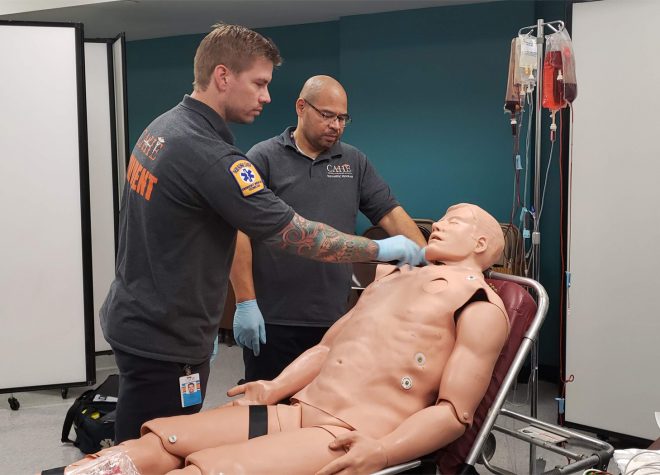
- Graduate with clinical maturity. By rotating through major hospital systems and 911 ambulance agencies you move beyond the classroom to master high-pressure patient care. You won't just learn the theory; you will build the "muscle memory" required to be a clinician from your first day on the job.
- Receive expert mentorship. Our instructors are active clinicians in their fields who teach you the nuances of the "hidden curriculum" - the soft skills, technical shortcuts, and patient-interaction techniques that separate a new graduate from a seasoned employee.
- CAHE's program is designed for efficiency and intensity, allowing you to enter a high-demand field in one year. We value your time by focusing only on the skills that lead directly to employment and patient outcomes.
- Students deserve a path to a new career that respects your current commitments. CAHE offers a flexible schedule including Daytime and Evening/Sunday schedules so you can maintain your personal and financial stability while you work toward your professional transformation.
Program Structure
Format: Blended/Hybrid
Clinical rotations: Begin in the First Term (596 clinical hours)
The Paramedic program features live, interactive lectures, utilizing robust online technology and is accessible from any device, giving our students the flexibility that they need. Upon enrollment in the Paramedic program, students will purchase an iPad to facilitate lectures. The program is 12 months in length and follows a convenient schedule, aimed to accommodate work schedules and provide more flexible schedule options to students. Students are required to complete 596 hours of clinical rotations on ambulances and at clinical sites.
Graduation Requirements
✓ Meet all academic requirements.
✓ Meet all clinical requirements and attain all required competencies.
✓ Successfully complete Career Development Workshop series.
✓ Receive certification in BCLS, ACLS, PALS, and PHTLS.
✓ Successfully complete the current version of the following FEMA Courses: IS-100, IS-200, IS-700, IS-800, IS-5 (NYS Requirement) or a HAZWOPER First Responder Awareness Level (National Registry Requirement).
✓ Meet all financial obligations.
✓ Complete an exit interview.
✓ Returned their CAHE swipe card, Clinical Affiliate ID cards, etc.
GPA Requirement: C+ average (GPA of 2.5)
Completion Window: Students who have not fulfilled their graduation requirements have 20 weeks from their originally scheduled graduation date to complete all missing requirements.
Certification & Licensure
Professional credentials and licensing requirements.
Certification Exam
NYS DOH EMS Written Exam, National Registry Computerized Exam and NYC REMAC Certification Exam
Licensure Required
Licensure is required to begin work in this field within the state(s) where students are currently located.
Click here for licensure requirements for all other states ↗Micro-Credentials
Upon successful completion of the program, graduates will also receive:
Basic Life Support (CPR) Certificate, Advanced Cardiovascular Life Support Certificate, Pediatric Advanced Life Support Certificate, Pre-Hospital Trauma Life Support Certificate, Blood Borne Pathogens (Infection Control), HIPAA
Mission & Goals
What we aim to achieve and how we measure success.
Mission Statement
Center for Allied Health Education's Paramedic Program has made a firm commitment to the education of students in the field of pre-hospital care. Our mission is the training of EMS Providers who are skilled individuals, qualified by technical education, to provide emergency medical services using the latest diagnostic and treatment modalities.
Goals
Course Schedule
Class and clinical scheduling information.
CAHE's Paramedic Program is offered in a hybrid/online format. It follows a convenient quarterly schedule, aimed to accommodate work schedules and provide more flexible schedule options to students. The Program is 12 months in length, divided into four 10-week quarters. 1) Lectures: Students attend lectures via a virtual synchronous classroom. Students can choose between day or evening lectures weekly throughout the program. Lectures meet 1-2 times per week and range between 1 and 3 hours each class/session. Actual lecture session hours vary by quarter. 2) Labs: Students attend labs in-person at their "home" location (Brooklyn or Staten Island campus). Students must choose which lab session/days to attend for the duration of the program. Labs are offered in a variety of options to provide students with maximum schedule flexibility. Actual lab session hours vary by quarter. 3) Clinical rotations: to be completed at affiliated hospitals and ambulance agencies. Students are required to complete an average of 8-24 hours of weekly clinical rotations each term, concurrently with their lecture and lab coursework. Students are advised on how to choose and schedule their clinical rotations at New Student Orientation.
Location
The program is offered in a Blended/Hybrid format. Courses take place on campus as well as online through synchronous and asynchronous methods of delivery.
Schedule Details
Spring Start Date: Daytime lectures will be conducted on Tuesdays between the hours of 9:00 AM-5:00 PM; Evening lectures will be conducted on Tuesdays & Thursdays between the hours of 6:00 PM–10:00 PM. Summer Start Date (BROOKLYN ONLY): Daytime lectures will be conducted on Wednesdays between the hours of 9:00 AM-5:00 PM; Evening lectures will be conducted on Mondays & Wednesdays between the hours of 6:00 PM–10:00 PM. Fall Start Date: Daytime lectures will be conducted on Mondays between the hours of 9:00 AM-5:00 PM; Evening lectures will be conducted on Mondays & Wednesdays between the hours of 6:00 PM–10:00 PM. Winter Start Date (BROOKLYN ONLY): Daytime lectures will be conducted on Thursdays between the hours of 9:00 AM-5:00 PM; Evening lectures will be conducted on Tuesdays & Thursdays between the hours of 6:00 PM–10:00 PM. Lab Schedule: Spring & Fall Start Dates: Lab sessions meet on most Sundays (only) for 6 – 7 hours. Summer Start Dates (BROOKLYN ONLY): Lab sessions meet on Mondays during the day for 6-7 hours. Winter Start Dates (BROOKLYN ONLY): Lab sessions meet on Wednesdays during the day for 6-7 hours or in the evening on Mondays & Wednesdays for up to 3.5 hours
Upcoming Cohorts
November 2026 (Brooklyn)
BrooklynStarts: November 30, 2026
Ends: November 2027
February 2027
Brooklyn, Staten IslandStarts: February 15, 2027
Ends: February 2028
Program Curriculum
Courses, hours, and what you'll learn.
The Paramedic program curriculum includes comprehensive coursework in pharmacology, anatomy and physiology, EMS operations, advanced airway management, cardiology, medical emergencies, trauma, women's health and pediatrics, along with extensive lab and clinical education.
Quarter 1
| Course Number | Course Title |
|---|---|
| EMTP 1112 | Pharmacology I |
| EMTP 1122 | Anatomy and Physiology |
| EMTP 1133 | EMS Operations |
| EMTP 1151 L | Paramedic Lab I |
| EMTP 1190 | Clinical Education I |
Quarter 2
| Course Number | Course Title |
|---|---|
| EMTP 1212 | Pharmacology II |
| EMTP 1241 | Advanced Airway Management |
| EMTP 1251L | Paramedic Lab II |
| EMTP 1290 | Clinical Education II |
Quarter 3
| Course Number | Course Title |
|---|---|
| EMTP 1313 | Cardiology |
| EMTP 1323 | Medical Emergencies |
| EMTP 1351L | Paramedic Lab III |
| EMTP 1390 | Clinical Education III |
Quarter 4
| Course Number | Course Title |
|---|---|
| EMTP 1413 | Trauma |
| EMTP 1423 | Women's Health and Pediatrics |
| EMTP 1451L | Paramedic Lab IV |
| EMTP 1490 | Clinical Education IV |
Program Outcomes
Below are the most recent outcomes, as reported to the Center's accrediting agency: ABHES (Accrediting Bureau of Health Education Schools) and CoAEMSP.
Reported to: ABHES
Reporting period: 7/1/2024 – 6/30/2025
Reported to: CoAEMSP
Reporting period: 01/01/2025 - 12/31/2025
Admissions Requirements
Prerequisites and eligibility requirements.
Applicants must meet the following requirements to be considered for admission to the Paramedic program.
General Requirements
- • Applicants must be 18 years of age or older prior to orientation.
- • Applicants must have completed a recognized high school or equivalent. Individuals who attended an online high school, or who were homeschooled, should contact the Admissions Department to determine their eligibility to enroll.
- • Applicants must be in good mental and physical health, free from any physical handicaps which would interfere with their work. Ultimately, individuals must meet the Technical Standards for Admissions listed for each program.
- • Have current NYS EMT certification (must be valid for the duration of the program).
Technical Standards
This policy outlines the technical standards that each applicant/student must be able to accomplish.
Each applicant/student must be able to:
- • Communicate effectively via telephone and radio equipment
- • Lift, carry and balance up to 125 pounds (250 pounds with assistance)
- • Interpret oral, written and diagnostic form instructions
- • Use good judgment and remain calm in high stress situations
- • Be unaffected by loud noises and flashing lights
- • Function efficiently without interruption throughout an entire work shift
- • Calculate weight and volume ratios
- • Read English language manuals and road maps
- • Accurately discern street signs and addresses
- • Interview patients, patient family members and bystanders
- • Document, in writing, all relevant information in prescribed format, in light of legal ramifications of such
- • Converse, in English, with coworkers and hospital staff with regard to the status of the patient
- • Perform all tasks related to the highest quality patient care
- • Bend, stoop and crawl on uneven terrain
- • Withstand varied environmental conditions such as extreme heat, cold and moisture
- • Work in low light situations and confined spaces
- • Work with other providers to make appropriate patient care decisions
Any applicant who does not meet the technical standards as outlined above is ineligible for admission to the school.
Any student whose status changes while enrolled and no longer meets the technical standards as outlined above may not be allowed to continue to progress through the program.
Admission Process
Step-by-step admissions instructions.
The admission process consists of three main steps: Application & Documents, Entrance Exam, and Interview.
- 1
STEP 1: APPLICATION & DOCUMENTS
Applicants should complete the general program application (www.cahe.edu/apply) along with a $50.00 (non-refundable) application fee. All required supplemental documents may be found on the "Application Checklist" and should be mailed/submitted in-person. Documents may either be submitted individually or together. All documents should be in prior to the scheduled interview date.
Apply Now - 2
STEP 2: ENTRANCE EXAM
Applicants who are exempt from the entrance examination requirement or successfully pass the required portions of the entrance examination will be scheduled to begin the interview process. Applicants who are required to take one or both portions of the entrance examination will be scheduled to do so.
- 3
STEP 3: INTERVIEW
A formal interview is required of all applicants as the last step in the admissions process. Applicants are encouraged to dress professionally and to familiarize themselves with the field, program structure, as well as accreditation.
Entrance Exam Exemption Criteria
Exemption from Verbal:
- •A minimum SAT score of 470 in Critical Reading or ACT score of 19 in English.
- •A minimum grade of a "C" on a college-level, credit-bearing English Literature course from a regionally accredited institution.
Exemption from Math:
- •A minimum SAT score of 490 in Math or ACT score of 20 in Math.
- •A minimum grade of a "C" on a college-level, credit-bearing Math course from a regionally accredited institution.
EMT Knowledge Exemption:
- •Applicants who have received an 80% or above on their most recent New York State Written Certification Examination (within the past 3 years) will be exempt from the EMT Knowledge section of the Entrance Exam.
Tuition & Fees
Tuition, fees, and payment-related details.
Tuition for the Paramedic Program (2025-2026) is $3,625.00 for each of the program's 4 quarters, and a total of $14,500.00 for the entire program.
Tuition
Total Tuition: $14,500.00 plus fees, or $17,135.
fees listed below
| Due | Amount |
|---|---|
| Tuition Enrollment Payment Towards Quarter 1 Tuition | $500.00 |
| Prior to First Quarter | $6,750.00 |
| Prior to Third Quarter | $7,250.00 |
Fees
| Category | Due | Amount |
|---|---|---|
| Registration Fee Non-refundable | Upon Registration | $100.00 |
| Clinical Fee Covers malpractice/liability insurance, lab operation, and clinical sites | Prior to the First Quarter | $500.00 |
| Technology Fee Online learning resources, learning management system, student portal, and computerized library | Prior to the First Quarter | $750.00 |
| Clinical Fee Covers malpractice/liability insurance, lab operation, and clinical sites | Prior to the Third Quarter | $500.00 |
| Technology Fee Online learning resources, learning management system, student portal, and computerized library | Prior to the Third Quarter | $750.00 |
| PSI Exam Fee Used to cover the NYS BEMS PSI's exam scheduling fee. This is a fee to cover one attempt. Additional attempts will require another PSI Exam Fee. | Prior to the Fourth Quarter | $35.00 |
Repeat Course Fee: This fee of $500 will apply to any term that a student is repeating a course that they previously failed.
Additional Costs
Clinical Clearance
$291.00
Students are required to have a physical examination and be medically cleared by a private physician, have a criminal background check performed, as well as provide acceptable proof of current health insurance coverage, prior to their acceptance into the program. The clinical clearance is performed annually through a third-party company called Castle Branch.
Textbooks
$1,500.00
Students are required to purchase all textbooks on their own.
iPAD AND ACCESSORIES
$465.00
Students are required to use the school-issued iPad when participating in virtual lectures, completing assignments, accessing Canvas and participating in exams. The cost of the iPad is due prior to Orientation and is non-refundable once the student has received the iPad.
Room And Board
At student's expense
Students are required to make their own arrangements for housing. The cost of room and board is at the student's expense.
Credentialing Examination
See board for current fees
Upon graduation, the student must apply for the NREMT Paramedic Certification Examination. Exam fees are set by NREMT and are at the student's expense; this cost is required for employment/credentialing, not to complete the CAHE program.
Professional Organizations
At student's expense
Students may wish to join one or more of the professional organizations in the field.
Financial Aid & Scholarships
Federal Financial Aid is available to eligible students, who apply. For more information, please refer to the Financial Aid section on this page.
For more information, please refer to the financial aid page .
Payment Plans
Payment Plans may be available to students on a case-by-case basis.
Refund Policy
Cancellation and refund details.
Enrollment Agreement Cancellation Policy
Students may cancel their enrollment agreement within seven (7) business days of signing the enrollment agreement, and will receive a refund of their registration fee and any tuition paid to date. Thereafter, a student will be liable for the non-refundable registration fee and any tuition liability as of the student's last date of physical attendance, pursuant to the Refund Policy as published in the Catalog.
After the first day of instruction, the student will be liable for the registration fee and any tuition liability as of their last day of physical attendance, defined as the last day in which the student participated in academically-related activity, including projects, clinical experience or examinations. The non-refundable application and registration fees, as well as items of extra expense to a student, (e.g. uniform, clinical and technology fees) will not be considered in tuition refund computations. Total tuition liability is limited to the quarter/semester during which the student withdraws or is terminated, as well as any previous quarters/semesters completed.
During the First Quarter of the Program
| Student's Last Date of Attendance | The School May Retain No More Than |
|---|---|
| 1st week of the Quarter | 0% of the total Quarter's tuition |
| 2nd week of the Quarter | 25% of the total Quarter's tuition |
| 3rd week of the Quarter | 50% of the total Quarter's tuition |
| 4th week of the Quarter | 75% of the total Quarter's tuition |
| 5th week of the Quarter | 100% of the total Quarter's tuition |
During the Second and Remaining Quarters of the Program
| Student's Last Date of Attendance | The School May Retain No More Than |
|---|---|
| 1st week of the Quarter | 25% of the total Quarter's tuition |
| 2nd week of the Quarter | 50% of the total Quarter's tuition |
| 3rd week of the Quarter | 75% of the total Quarter's tuition |
| 4th week of the Quarter | 100% of the total Quarter's tuition |
Accreditation
Programmatic and institutional accreditation.
-
CAAHEP
Accreditation -
NYS DOH
Accreditation
Employment Opportunities
Where graduates work and what certifications open the door.
NREMT
Credentialing exam
NYS DOH EMS Written Exam, National Registry Computerized Exam and NYC REMAC Certification Exam
State licensure required to practice. See professional licensure by state .
Additional certifications you may earn
- Basic Life Support (CPR) Certificate
- Advanced Cardiovascular Life Support Certificate
- Pediatric Advanced Life Support Certificate
- Pre-Hospital Trauma Life Support Certificate
- Blood Borne Pathogens (Infection Control)
- HIPAA
Clinical Geography
Where students train across the New York metro area.
Clinical education connects classroom learning to affiliated healthcare sites across Brooklyn, Staten Island, and other nearby parts of the New York metro. Placements depend on program requirements, site availability, and affiliation arrangements—not every student is assigned to the same site.
Training locations for this program
- Brooklyn
- Staten Island
Site names, neighborhoods, and program coverage on the Clinical Education Sites hub reflect representative partner affiliations. Specific student placements vary by cohort, schedule, and clinical capacity.