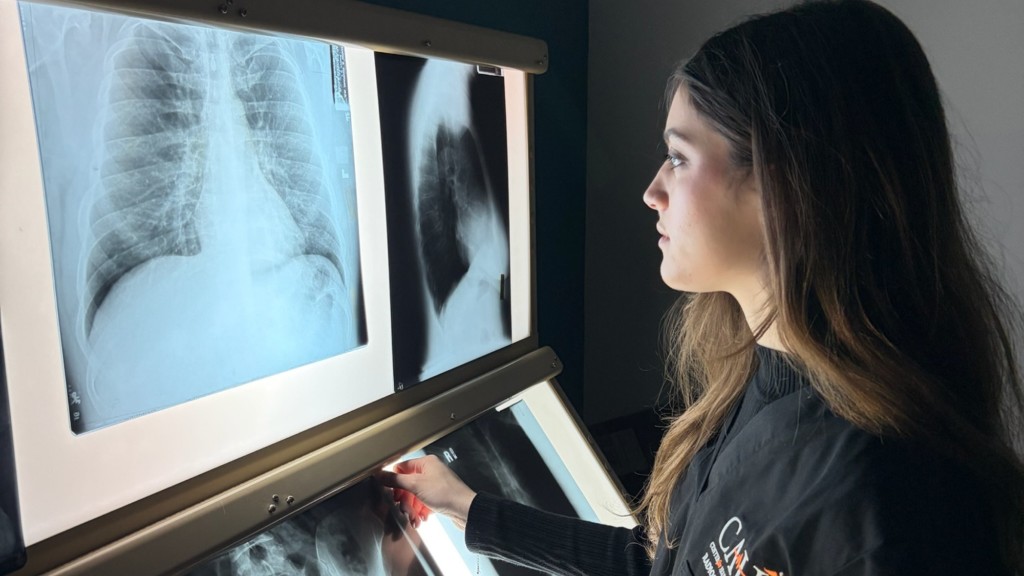
Students in CAHE’s Radiography program are preparing to enter a profession where artificial intelligence is becoming an increasingly useful tool. AI can help organize images, prioritize urgent cases, and improve workflow, but it cannot replace the judgment, communication, and patient-care skills of trained healthcare professionals. That is where CAHE’s education and clinical preparation remain essential.
Artificial intelligence (AI) is transforming many industries, and healthcare is no exception. In radiology, AI has become one of the most talked-about advancements because the field relies heavily on analyzing medical images. For years, some experts predicted that computers might eventually replace radiologists. Today, however, the reality looks very different. Rather than eliminating radiology careers, AI is becoming a tool that helps imaging professionals work more efficiently and meet the growing demand for diagnostic care.
According to a recent CNN Business report, radiology has become a “case study” for why AI is more likely to support healthcare workers than replace them. AI is already being used in imaging departments to help sort through large amounts of data, organize exams, and prioritize scans that may require immediate attention. This process, often called triage, helps radiologists identify urgent cases faster and manage increasingly busy workloads.
Dr. Po-Hao Chen, a diagnostic radiologist at the Cleveland Clinic, explained that AI plays an important role in helping organize data and flag exams that need attention. However, the report emphasizes that the majority of image interpretation is still performed by human radiologists. AI can assist with workflow, but it does not replace the medical training, judgment, and decision-making required to interpret imaging studies accurately.
This is an important distinction for anyone considering a career in radiology or medical imaging. AI may help identify patterns or prioritize cases, but trained professionals are still needed to review images, understand the clinical context, and ensure patients receive accurate care. Technology can support the process, but human expertise remains essential.
Experts quoted in the report echoed this point. Jack Karsten, a research fellow at Georgetown University’s Center for Security and Emerging Technology, told CNN, “It’s not only not replacing those workers, but it’s actually increasing the amount of work they can do and increasing demand for their services.”
That message is especially encouraging for future radiology professionals. Instead of reducing the need for trained workers, AI may allow healthcare systems to serve more patients while making imaging departments more efficient. As demand for medical imaging continues to rise, professionals who understand both technology and patient care will remain highly valuable.
Dr. Shadpour Demehri, an interventional specialist at Johns Hopkins, shared a similar perspective. He told CNN that AI is “something that doesn’t replace anyone, that just makes our job more efficient and more meaningful.”
This reflects the way many healthcare technologies are used in practice. New tools are not designed to remove the human element from patient care. Instead, they help professionals focus their time and skills where they matter most. In radiology, that means using AI to support workflow while radiologists and imaging professionals continue to provide the expertise behind accurate diagnosis and treatment planning.
A growing field—not a shrinking one
The growth of AI in radiology is already significant. The report notes that there are now more than 1,000 FDA-cleared AI tools in medical imaging, far more than in other areas of medicine. These tools are being developed to assist with imaging analysis, workflow management, and case prioritization. Even with this rapid growth, the demand for radiology professionals is not shrinking.
In fact, the U.S. Bureau of Labor Statistics projects that radiology-related employment will grow by 5% through 2034, which is higher than the 3% growth projected across all occupations. Job posting data from Indeed also shows that radiology job opportunities have increased over the past five years rather than declined.
Several factors are contributing to this continued demand. As the population ages, more patients need diagnostic imaging to evaluate injuries, detect disease, monitor conditions, and guide treatment decisions. Advanced imaging has also become a central part of modern healthcare, meaning physicians increasingly rely on scans to make informed decisions. AI may help manage the growing volume of imaging exams, but trained professionals are still required to operate within this evolving healthcare system.
How the conversation around AI has matured
The article also points to a notable shift in thinking from Geoffrey Hinton, one of the best-known figures in artificial intelligence. Years ago, Hinton suggested that medical schools should stop training radiologists because AI would take over the field. More recently, he clarified that he now believes AI is more likely to make radiologists much more efficient while also improving accuracy.
This change in perspective shows how the conversation around AI and healthcare has matured. The future is not simply about machines replacing people. Instead, the future is about professionals learning how to use advanced technology to improve care, efficiency, and outcomes.
For students interested in healthcare, radiology offers a strong example of how technology can make a career path even more exciting. The field continues to evolve, and future imaging professionals will need to be comfortable working with advanced tools, adapting to new systems, and understanding how technology fits into patient care. This creates opportunities for students who want a career that combines science, technology, and meaningful impact.
What this means for future imaging professionals
For students considering a future in healthcare, radiology continues to offer strong career opportunities despite the rapid growth of artificial intelligence. As imaging technology advances and healthcare systems care for an aging population, the need for diagnostic imaging professionals is expected to remain strong. AI is helping radiologists work more efficiently by organizing data and supporting workflow, but it still depends on trained professionals to interpret findings, apply clinical judgment, and ensure high-quality patient care. Rather than replacing careers in radiology, these technological advancements are creating a field where healthcare professionals can combine medical expertise with innovative technology. Students entering the profession today will have the opportunity to work alongside cutting-edge tools while continuing to play an essential role in diagnosing disease and improving patient outcomes.
CAHE’s Radiography program helps students develop the technical abilities, professional judgment, and clinical experience needed to work confidently alongside evolving imaging technologies. AI may continue to change how radiology departments operate, but trained healthcare professionals will remain responsible for interpreting findings, communicating with patients, and ensuring that technology is used safely and appropriately.
Source: Radiology Business / CNN — “Radiology has become a case study for why AI won’t replace human workers” (2026).